
 The
Glassware Gallery
The
Glassware Gallery
The joint size is described by a number of the form xx/yy. The first number denotes the outside diameter of the top of the tapered male joint (or inside diameter of the top of the female joint) and the second number denotes the length of the joint. For example, a 14/20 joint (pronounced "fourteen-twenty") is 14 mm wide at the top and is 20 mm long. 19/22 and 24/40 are two other very common joint sizes.
As each joint has a standard taper, any two joints with the same outside diameter can fit into each other as long as the apparatus to which they are attached does not interfere. For example, a 14/35 joint on a condenser will fit into a 14/20 flask although the ground glass joint will protrude (35 - 20) 15 mm into the flask.
Note:

The grease you select will depend on the nature of your experiment. For routine work, a simple silicone grease will be fine. For high vacuum applications, more expensive greases such as Apiezon H or M grease should be used.
To grease a joint, first make sure that both the male and female halves are completely clean and free of old grease or particulate matter. The ground glass should be clean and frosty in appearance; if not, wipe them with a clean KimWipe that has been moistened with hexane, petroleum ether or a similar solvent.
Apply a small dab of grease about the size of a pea to your fingertip and then smear an even band around the top half of the male joint only. By keeping the grease in the top half of the joint you reduce the chances of contaminating your reaction mixture with excessive amounts of grease. Slide the greased male joint into the female section. Fit them together snugly and rotate/wiggle the male portion slightly until you have a clear band of grease that has no streak or bubbles. If you can't work out any streaks/bubbles with additional rotation/wiggling, take the joint apart, clean both halves completely and start over. Adding more grease to a streaked joint is usually not worth the effort.
If you plan on heating or refluxing your material, recognize that
the grease will slowly dissolve away into your reaction vessel. If you
will be distilling the material this may not matter, but if not and you
have a material that has solubility characteristics similar to grease or
a reaction that needs to run for several days, then you may need to rethink
your approach. Solutions include keeping your system under positive pressure
and substituting PTFE (i.e. Teflontm) sleeves or Teflon tape
for grease. We recently learned of another alternative, the Glindemann
sealing ring, which is a narrow PTFE ring that is supposed to fit better
than a conventional joint sleeve or Teflon tape.
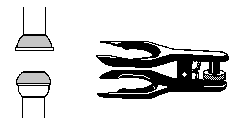
The joint size is described by a number of the form xx/yy. The first number denotes the width of the ball and the second number denotes the interior bore of the joint. For example, a 12/2 joint has a 12 mm ball and with a 2 mm hole.
The instructions for greasing a ball and socket joint are the same as those listed for greasing a standard taper joint.
Yes, your leg and hip form a ball and socket joint, but hopefully
yours are not made out of glass!

O-rings have distinct advantages over standard taper joints in that they are unlikely to leach grease into a reaction mixture and they are virtually incapable of siezing. However, O-ring materials can degrade when used with certain solvents or subjected to high temperatures (think about the Challenger disaster).
O-ring joints should not be greased, however the O-ring itself
should be treated with an extremely thin coating of grease. A good
way to do this is to simply rub your nose with your thumb and forefinger
and then rub the O-ring (honest. No kidding). Alternatively, Apiezon M
grease is a good choice. When assembling an O-ring joint, be careful that
no hairs or fibers stick to the O-ring as these will cause a vacuum leak.
Also make certain that the O-ring is fully seated in the groove.

This page was last updated Friday, January 11, 2002.
This document and associated figures* are
copyright 1996-2002 by Rob Toreki.
Send comments, kudos and suggestions to us
via email.
*Some of these figures are adapted from the
Chemglass, Inc. catalog and have been reproduced with permission.